


Kiss of the Spider Woman
Classical Framing, Modern Techniques
A Conversation with John “Buzz” Moyer, SOC
By David Daut
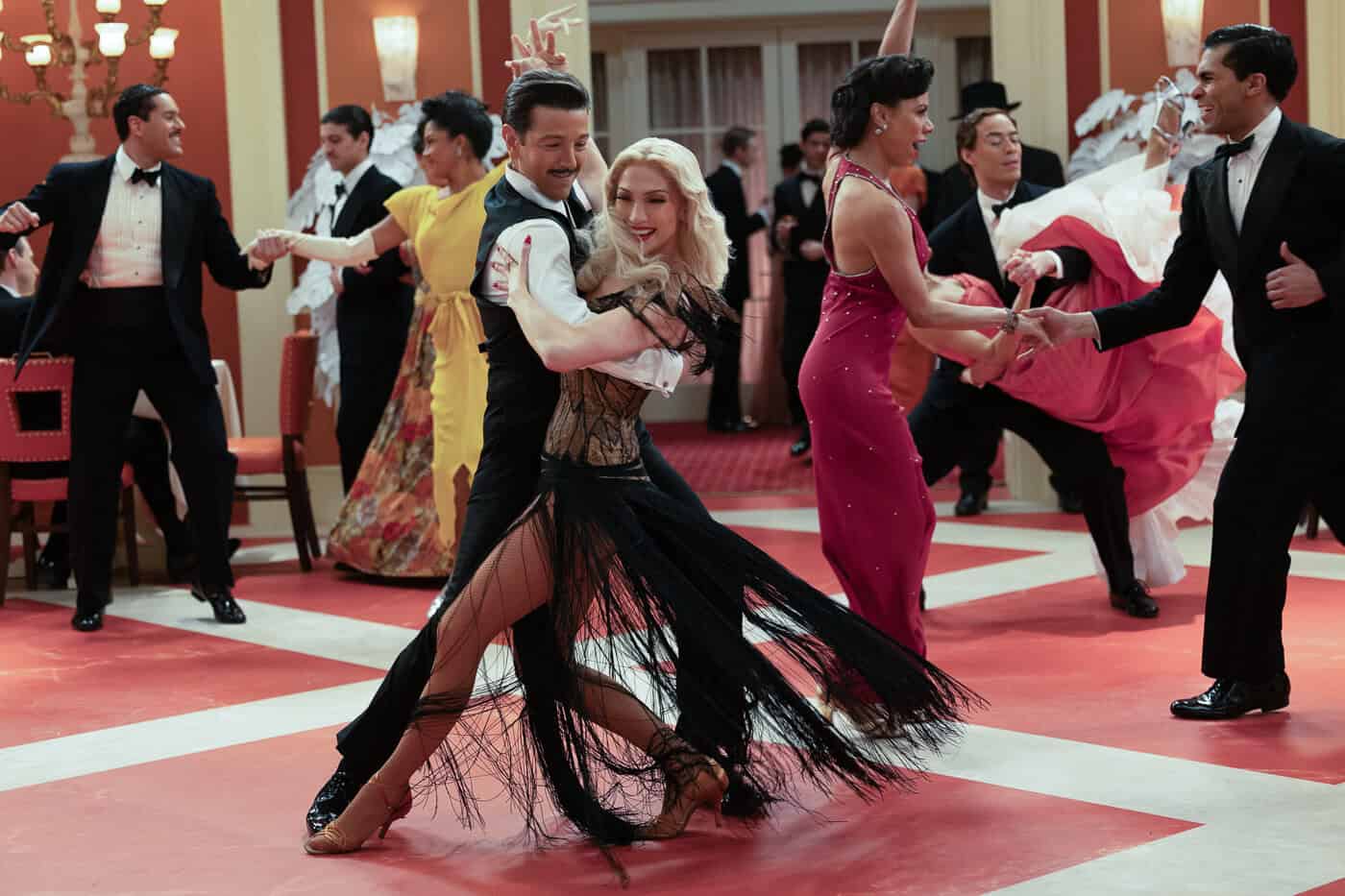
Based on the stage musical adapted from Manuel Puig’s 1976 novel by John Kander, Fred Ebb, and Terrence McNally, Kiss of the Spider Woman contrasts the bleak reality of its principal characters against the romantic, Technicolor fantasy and spectacle of a movie musical from the Golden Age of Hollywood. Bill Condon’s film adaptation draws a starker line between these two modes by having the film’s musical numbers almost entirely contained in the film-within-a-film of Molina’s fantasies.
Camera Operator spoke with A camera operator John “Buzz” Moyer, SOC, about his work on the musical sequences for the film, what it was like evoking this classic style of filmmaking, and the challenges—both creatively and technically—that came with making a film in 2025 that feels like a lost relic of the 1940s.
Set against the backdrop of political revolution in Argentina, political prisoner Valentin Arregui is made to share a cell with Luis Molina, a queer window dresser who was arrested for public indecency. Unbeknownst to Arregui, Molina is being pressured by the prison warden to gather information about the revolutionary and his associates in exchange for a reduced sentence. As Molina weighs his loyalties, he escapes into a world of fantasy by recounting the story of his favorite movie musical, “Kiss of the Spider Woman.” Kiss of the Spider Woman is written and directed by Bill Condon and stars Diego Luna, Tonatiuh, and Jennifer Lopez.

Camera Operator: The last time we talked was about Steven Spielberg’s West Side Story. In terms of shooting musicals, in what ways do you think your work on West Side Story influenced your work here, and in what ways was Kiss of the Spider Woman its own unique challenge?
John “Buzz” Moyer: With West Side Story we were shooting anamorphic, so we had a lot of room laterally to let the actors and the dancers do what they do. If you’re operating for dance, you need to be there before the end of the phrase. If you’re following them, you’re going to be late. You want to get the camera to where they’re landing so that when they land, the camera is still. With West Side Story being anamorphic, we had a lot more room to allow the actors and dancers to play, whereas in Kiss of the Spider Woman, Bill Condon, the director, and Tobias [Schliessler, DP] wanted to make it 4:3 format so it felt more like the giant dance numbers of the 1940s. Because of that, you’re more limited for lateral movement, and because we did all the dance numbers on variable length cranes, like Technocranes and Scorpios, it was difficult to make sure that you landed there at the same time.
All three of us—myself; the dolly grip, Moose [John Moustakas]; and the pickle operator, Matt Setton—had to be in sync in making sure that we would get there before the dancers got there. Because there was music going, we were able to work through those things. It took a week for all of us to get it together so that we’d all be at the same spot; myself doing the pan and tilt while Moose and Matt placed the camera physically in space based on where the actors would be and how we wanted the dancers to line up in the shot. Having to have three people operate the positioning of the crane was definitely a challenge, but it was a great challenge for me. I really enjoyed having that opportunity.
Also, Jennifer [Lopez] is such a pro. She really was something else. I think she might have tripped or messed up once through all of the many sequences that we did. She made it very easy for all of us in terms of repeatability.
CO: It’s interesting, the film exists in these different modes. You have the big, ’40s-inspired, classical musical stuff in the film-within-a-film, and then you have the frame narrative in the prison. My understanding is that you primarily worked on the ’40s-style musical members, correct?
Moyer: Yeah, that’s right. I had committed to another job while the production was going to Uruguay, so I worked on the stuff we shot on stage in New Jersey. I did all the dance numbers with Jennifer and everyone else. We may have done one or two scenes in prison sets on the stage, but Jennifer was involved in those. There was a whole other crew over there. I think Basil Smith, the first AC, went over to do that, but as far as operators, none of us from the States were there.

CO: In terms of these musical numbers, you’re obviously throwing back to the big, classic musicals of the 1940s like Singin’ in the Rain and An American in Paris. How much of those classic films did you look back on to draw in inspiration for what you were doing here versus just organically finding things in the moment?
Moyer: I think things did happen organically, but it happened because of Bill’s experience and because Tobias had done so much pre-production. I did look at a lot of those classic dance numbers mostly because of the limitations of the equipment back then. They were these giant cranes that moved very laterally; very in and out, pan left and right. Because of the newer cranes and technology that we have with stabilized heads and such, the question was do we want it to feel like this huge, rocking thing going in? Because they’re basically these Brooklyn Bridge–like structures with 400-pound cameras attached and three people on the end controlling it.
Ultimately we said no, we’re not going to do that, but we’re going to try to emulate the same feel of the camera being on tracks. Going in and out, letting something happen, push in on that moment, and then come back wide and show everyone as a group. It was definitely something that we talked about early on, and when Tobias called me early about the job, I asked all these questions, how we want it to feel. The discussion was had, but then as we were shooting, we would rehearse the big numbers, see what would happen, and Bill and Tobias would decide what direction we’re shooting. A lot of that was just based on the production design and how the proscenium was set up like a stage. We’d get the finder and start feeling some shots out, and as we’d go through we’d realize that we can’t be there for that moment, so we’d have to make adjustments.
There was a lot of that going on throughout different takes, but still trying to make it as efficient as possible because there’s a lot we had to get done. And, of course, we don’t want to wear out the dancers. Jennifer was doing a lot, so we want to make sure that we get it and don’t flip a headroom or miss something. I had to make sure Matty and Moose knew where to be because I need room to pan or correct headroom and not miss lights. There’s a lot of those discussions that the three of us had to solve these problems, making sure that we would get what we had to get. And we’d get input from Bill and bounce ideas back and forth. It was a totally collaborative thing, which was fantastic. It had to be collaborative because there were so many moving parts that we wanted to make sure that we got it, and got it well.
CO: It’s an interesting challenge doing something that is deliberately throwing back to an earlier style of filmmaking, but still using modern tools and all the freedom and flexibility that comes with that. How do you strike that balance between staying true to the aesthetic of the past while still using modern tools and modern sensibilities?
Moyer: Like I said, because these sequences are 4:3, that immediately puts it in a different period. It’s not 1.85:1, it’s not widescreen. I think that an audience would see that and say, “Oh, this is different.” And we were on the same wavelength, even to the point where if we did a scene with the four actors, the question would be are we going to cover this, or are we just going to let it play? Bill would say, “Well, we could cover.” I’d say, “Back then they never really covered things like this. They’d walk in, say the lines, there would be a slow push in, and they’d leave.” So Bill says, “Okay, great. Let’s do that.”
It’s kind of cool to just not give the editor options for cutting. Obviously, we’d give options if there was a line that needed to be highlighted or we just had to compress time. Then we’d start in a wide, cut to a two-shot, then a three-shot, and then it leaves. But we always had that in the back of our mind; would they do this back then?
As far as the modern technology, again, we wanted to make sure everything was very linear. When we would do moves with the crane, we try to keep it either extended and make the move, or gradually pull back because we wanted to have that sense of the weight, like the equipment those technicians operated back in the day. Sometimes we would be faster or slower just because we wanted that impact, and they didn’t have that option back then because moving these things at that speed was not possible. So, that was kind of the modern take on the old school thing, but generally we tried to keep it feeling like the old ’40s stuff.
CO: I think maybe the most spectacular number of the film is “Gimme Love.” Can you talk a little bit about what went into filming that particular sequence?
Moyer: Yeah, it was big. That was great, and we were mixing a lot of different sizes because we wanted to see the faces. We’re mixing a lot of tighter, but still wide-enough coverage that would let us see the emotions on the faces of the actors, but also show the dancing and the bodies and the physicality of the scene. A lot of those were very much storyboarded so that Bill had the moments that he really needed in his head.
My favorite scene was in the jungle with Jennifer on the web. Her voice in that was incredible, and just her expression and the costume. I think they went to every Home Depot and Lowe’s store for miles and brought in all the greenery to make it look like that. Those guys were fantastic, having to move things to get the crane in. Logistically, some of those sets were tough. It was tough to move around in there. Where the camera would start, we’d turn trees, or add trees, or just add a branch sticking in front of the camera so we can get that reveal. But we’d also have to block lights because in 4:3, we have so much more headroom. There’s only so much room in a set to hide the lights, so we were strategically placing branches and trees and things like that just to block lights as we went through. Again, it was a challenge, but it was a welcome challenge.
Every day going to work, it was like, “Okay, here we go. Let’s make this work.” Having the experience of doing West Side Story, as well as having been a dancer as a kid, every time you hear “five, six, seven, eight” I’m all ready to go. And being a drummer and knowing timing and clicking and knowing that the downbeat was going to happen here, I could start, making sure that we—Matty, Moose, and I—were all moving in concert with each other. Having that experience was great.

CO: How much rehearsal time did you get on this? Were you there working with the dancers and the cast on making sure that all the moves were choreographed ahead of time, or was it much more finding it in the moment?
Moyer: Obviously they had choreographed all the dances way in advance, so that was all done. Bill and Tobias had scouted, and they’d had weeks to figure out where they’re going in the sets. They’d seen the sets being built, and they had a rough idea of how they wanted to see it. The nuance of it and the timing came on the day, and it was all in the trust that they had in me.
Sometimes we’d do one rehearsal, but a lot of times we just had to go. We have to be here, here, and here, and we just have to figure it out. That was a great challenge. And the trust that they had in me to get this and get it quickly was great. To be able to deliver what they really wanted, and still make suggestions. It’s very much a collaborative thing, which I really enjoyed.
CO: We talked a little bit about “Gimme Love,” and we talked a little bit about shooting in the jungle sets. Were there any other particularly challenging moments of the shoot that come to mind?
Moyer: Really, the most challenging thing was for the three of us was working around the dancers. A lot of times there were dancers crossing the camera, so trying to find these places to move the camera and to get the camera past people’s shoulders and over their heads, or pulling quickly back without hurting anyone was a priority. The crane can extend very quickly and it can come back very quickly, so if you’re moving it laterally and a dancer is not paying attention, you can hit them. That was definitely a concern. Every time we would be doing these big sweeping moves, we had to coordinate with the choreographer and the dancers who might possibly be in the way. Again, everything’s choreographed by numbers. Everyone is on the same spot every time. It’s not just actors moving through a set talking; these are very much choreographed and you know where the heads are. Dancers are incredibly precise in that way. I think they have eyes all around their head. They can feel when something’s going to happen.
It took a little bit for Matt to be confident to just go. If you delay because you’re worried you’re going to hit somebody, it’s like, no, you weren’t going to hit somebody. You have to just go. They’re not going to get hit. That was one of the biggest challenges, to make sure that the crane was not only safely put where it had to be, but also to have everyone on board knowing that we’re going to do this, and trusting that everyone is going to be in the right place. That was a challenge for all of the dances where you see multiple dancers in the shot. Coming back and over, and then sweeping past people and going in. That, ultimately, was the biggest challenge.
Beyond that, just making sure I don’t see lights if Jennifer’s being lifted. We can’t shoot low because we see all the lights, so when those lifts would happen, we’d have to come back and go high to then reveal the lift over a certain height. Every shot had a certain challenge. Sometimes some of the sets had pillars in them we couldn’t go around, so moving the crane base was important. Every day was a challenge in that way, which was great.

BEHIND-THE-SCENES
Select Photo for Larger View


Above Photo: Jennifer Lopez in KISS OF THE SPIDER WOMAN
Photos courtesy of ROADSIDE ATTRACTIONS
TECH ON SET
Libra Remote Head on a Scorpio Crane
ARRI ALEXA Mini LF Camera
Sony VENICE 2 Camera
ARRI DNA LF Lenses
Cooke Panchro/i Classic FF Lenses
RELATED CONTENT
Watch the trailer for Kiss of the Spider Woman
John “Buzz” Moyer, SOC
Learn more about Buzz’s career and projects at IMDb.com
“West Side Story: Musical on a Massive Scale,” Winter 2022 Camera Operator
Content Portal
SOC presents “Operator to Operator” at ARRI Rental NY
SOC Lecture Series, Class 3: The Work of the Operator / Setting Up the Shot
BEHIND-THE-SCENES
Select Photo for Slideshow
SIGN UP FOR THE FREE
DIGITAL EDITION OF
CAMERA OPERATOR
Click Here
ENJOY PAST ISSUES OF
CAMERA OPERATOR
Click Here
John “Buzz” Moyer, SOC
Buzz began his career after graduating from Ithaca College in 1986. Starting in the corporate and commercial world in Pittsburgh, he went on to features and television in the Grip department and moved into camera. “Every day was a learning experience, and eventually provided the funds to purchase a Model 2 Steadicam in 1989, which was a dream of mine since seeing Wolfen in College.” John built his skills and client base, and after the required “10,000 hours,” continued relationships that would lead to more and more opportunities to learn and understand the role of a Steadicam operator and, more importantly, the responsibility and role of a camera operator. Thirty-two years later, John has been fortunate to work with a list of respected DP’s and directors. “I am very lucky to be here. I am thankful for all the mentors along the way and those that trusted me to do the job.” John hopes he can do the same for many who aspire to be a camera operator.

A writer and critic for more than a decade, David Daut specializes in analysis of genre cinema and immersive media. In addition to his work for Camera Operator and other publications, David is also the co-creator of Hollow Medium, a “recovered audio” ghost story podcast. David studied at the USC School of Cinematic Arts and works as a freelance writer based out of Long Beach, California.
SPECIAL THANKS TO OUR ADVERTISERS

